Use case · Form 01
Round tables
A round top cut to the exact diameter the room wants — not the nearest size a catalog stocks. Ten species, face grain or end grain, priced live as you turn the one dial that matters.
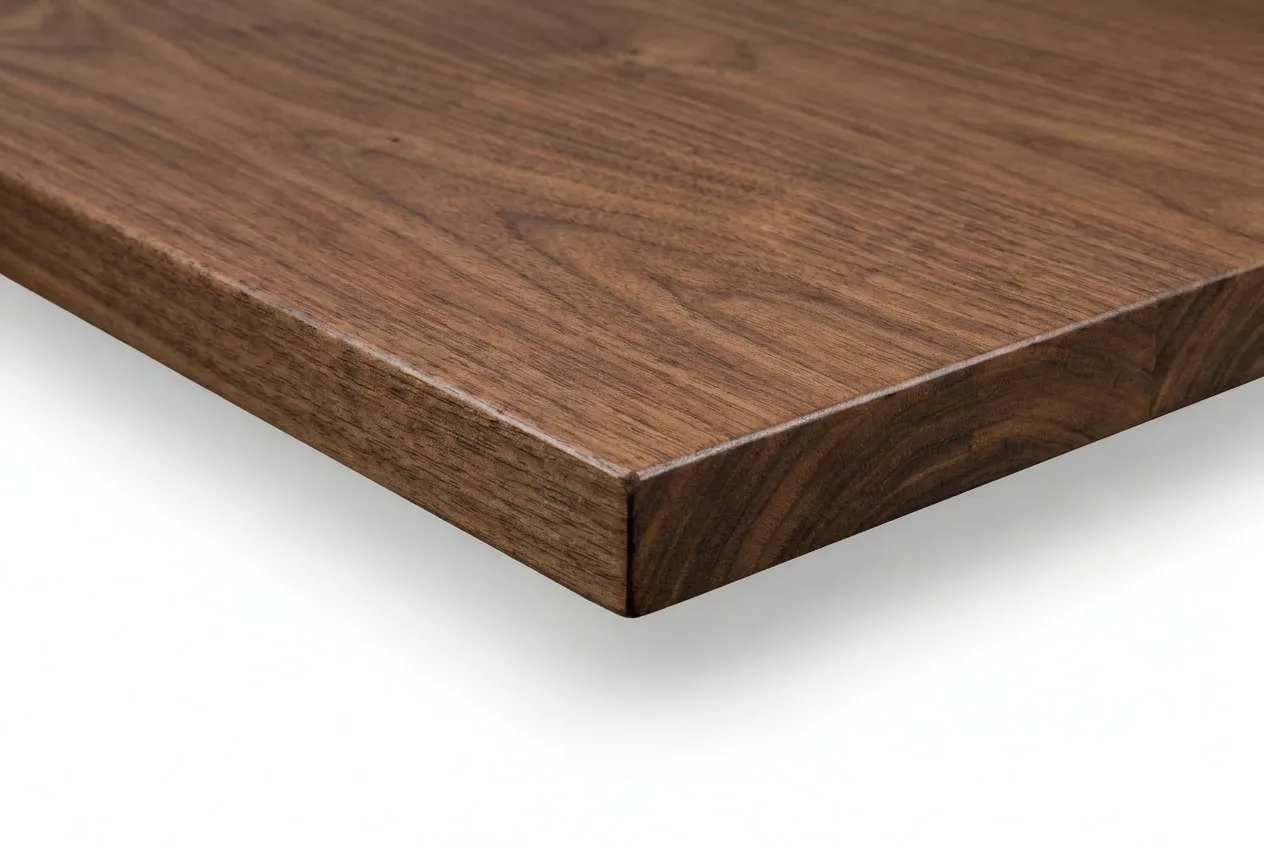 WALNUT · ALTERNATE VIEW
UNDECIDED? — HELP ME CHOOSE A SPECIES →
02Size
FACE · EDGE · END, COMPARED — THE THREE BUILDS →
THE PROFILES, DRAWN → · OUR HAND-CARVED LIVE EDGE →
UV-CURED · ZERO-VOC · REPAIRABLE IN PLACE — ABOUT THE COATING →
CUSTOM SHAPES — BY QUOTE · MATERIAL IN HAND — GET SAMPLE
Sizing a round top
Rounds seat by circumference: Ø 36 in is the classic bistro two-top, Ø 48 seats four, Ø 54 to 60 seats six, and Ø 72 seats eight with room for the middle of the table to still work. Conversation is the round's whole argument — everyone faces everyone — so err toward the smaller diameter that fits the walkways; you lose nothing but reach.
How it configures
Switch the shape to round in the tabletop configurator and the drawing redraws as a circle with the diameter dimensioned. Set it to the sixteenth of an inch, pick species and thickness, and the price follows live. Machined edge profiles — chamfer, roundover, ogee — run the full rim; a hand-carved live edge stays with rectangular tops, since a natural line can't run a circle.
The base underneath
Most rounds live on pedestals, and pedestal geometry is forgiving: the top just needs honest thickness where the base plate lands — 1 3/4 in suits most single-pedestal dining bases. Building to a base you already have or one your designer specced? Set the numbers to its plate and you're done. Need the base built too? That runs through the custom path.
Questions
- What diameters can you build?
- Any diameter, set to the sixteenth of an inch — there is no size list. Common builds run Ø 30 to 36 for bistro and restaurant two-tops, Ø 48 to 60 for dining, and Ø 72 and up for large rooms.
- How many people does each diameter seat?
- Roughly: Ø 36 seats two, Ø 48 seats four, Ø 54 to 60 seats six, Ø 72 seats eight. Add a seat's worth of comfort by stepping up one size when the room allows.
- Can a round top have a live edge?
- No — a live edge is a natural line along a board's long sides, and a circle has none. Rounds take the machined profiles instead: squared, chamfer, roundover, or ogee, run around the full rim.
- Will it fit my pedestal base?
- Almost certainly — pedestal bases accept any rigid top that covers their plate. Check the base maker's minimum top diameter and thickness; 1 3/4 in covers most dining pedestals.
The full form: TABLETOPS → · Other uses: Dining tables · Desks · Bar tops · Restaurant tables · Wood countertops